World War I decimated Europe between 1914 and 1918 and led to the deaths of over two million people. It is commonly agreed that the assassination of Archduke Franz Ferdinand of Austria-Hungry was the direct impetus for this monumental, international conflict. Rajiv Joseph’s Archduke plays with the story of assassin Gavrilo Princip and his co-conspirators Trifko Grabež and Nedeljko Čabrinović. These young men were citizens of Bosnia and Herzegovina, who felt Austro-Hungarian oppression of the Balkan region. Located in the Southeast of Europe, the Balkan region was the site of constant conflict due to bordering Eastern and Western powers. Today the region encompasses Albania, Bosnia and Herzegovina, Bulgaria, Croatia, Kosovo, Montenegro, North Macedonia, Romania, Serbia, Slovenia, as well as parts of Turkey and Greece. Before the assassination, tension between Austria-Hungary and Serbia had been mounting for years alongside a rise in Panslavic ideology. Throughout the play, Dragutin “Apis” Dimitrijević, a Serbian solider and nationalist, uses the history of the region to inspire the assassination of the Archduke. While it isn’t necessary to be an expert in the geopolitical climate of this region at the time in order to have a meaningful experience of Archduke, the following can give insight seekers an additional layer of context for the events of the play.
The Creation of Austria-Hungary.
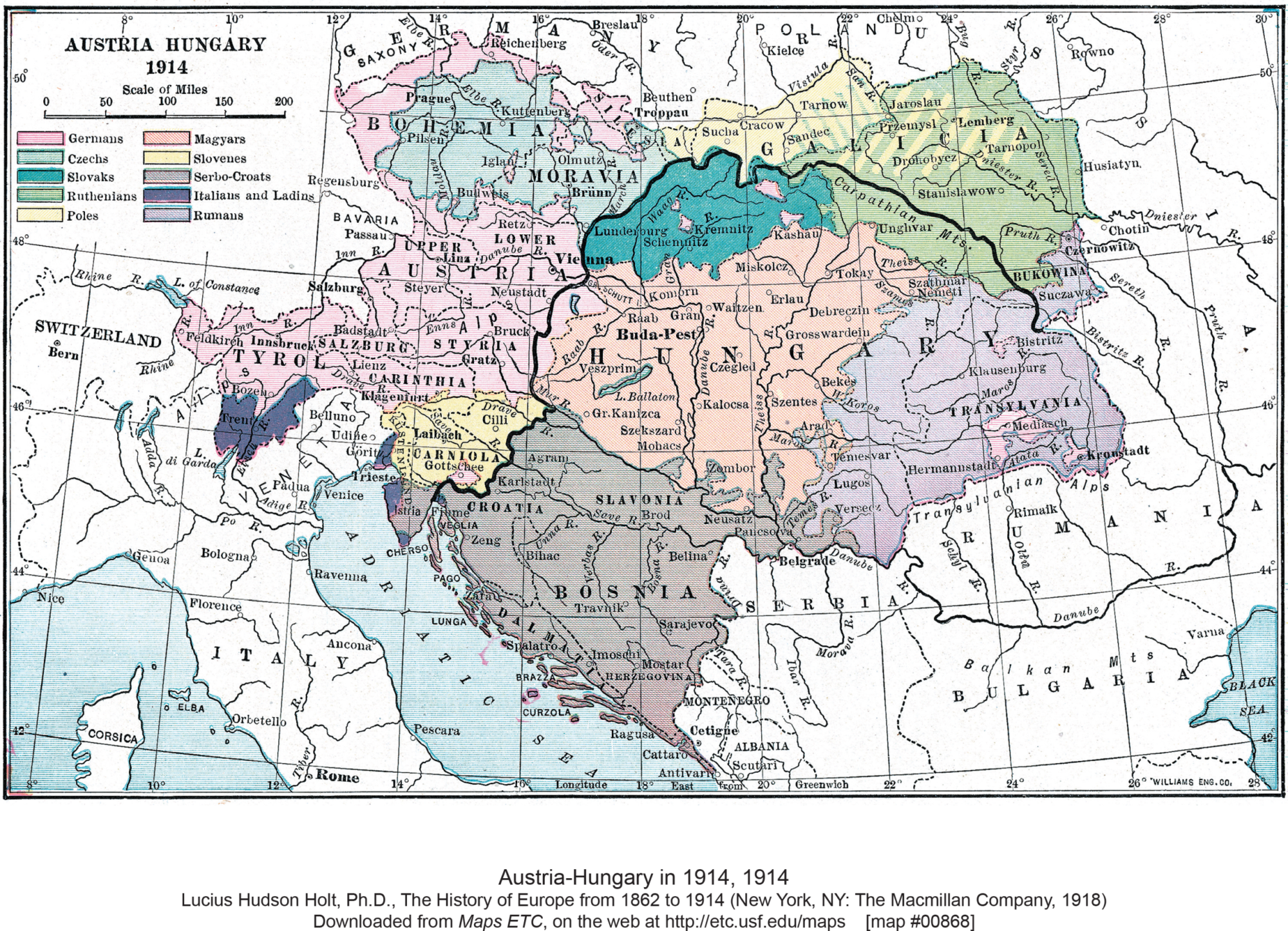
Austria-Hungary, also called the Austro-Hungarian Empire, was a central European monarchy that existed from 1867 until 1916. It was controlled by the Hapsburg family. This part of Europe was at one time part of the Holy Roman Empire, which collapsed in 1806. Between 1806 and 1867, the Hapsburgs struggled through conflict with other former parts of the Holy Roman Empire and discontent within their own empire.
The people of Hungary were not happy living under Austrian rule. Tensions came to a boiling point in 1848, when the native people of Hungary started to rebel. Austrian troops and Hungarian citizens remained at conflict until 1867 when the dual monarchy was established. Known as the Ausgleich (Compromise), this agreement-maintained Franz Joseph as emperor and King of Hungary but granted both Austria and Hungary their own political system, including a parliament, prime minister, cabinet, and dedicated military. Together, they jointly administered three governmental branches: the Common Ministries for Foreign Affairs, War, and Finance.
While the Compromise helped to assuage political tensions in the region, it did not totally satisfy the diverse population of the area. Hungarians, Magyars, Slovaks, Czechs, Poles, Ukrainians, Slovenes, Croatians, Serbs, Romanians, Italians, and Slavs all lived within the region, and finding a way to govern all the groups was nearly impossible. Nationalism was on the rise in Europe, and people found camaraderie with others who shared their ethnicity, leading to discrimination in work, education, and political matters. Slavs—those who spoke any of the Slavic languages of Eastern Europe—faced the worst treatment.
The conflict was exasperated by the Hungarian government seeing orders from the capital as suggestions rather than demands. While Hungary itself is not considered Slavic, many citizens and officials within Hungary began to support Panslavism, a movement that sought to unite all the Slavic people to work toward common political goals, one of which was to free Slavic peoples from non-Slavic rulers. Concurrently, political instability continued in Austria. While Emperor Franz Joseph remained in power, he lost all of his sons and remained with no heir; he named Archduke Franz Ferdinand as his successor in the 1890s.
Serbia, Bosnia, and Herzegovina’s Struggle for Independence.
In the 600s CE, the Balkan region now known as Serbia, Bosnia, and Herzegovina was occupied by the White Serbs. Individual tribes put down roots, creating civilizations for themselves, developing language, culture, and history. Over the years, the tribes would slowly combine to become the Serbian Empire, despite their different languages and cultures. In the 14th century, Serbia came under attack by the Ottoman Empire, which hoped to extend power in the Balkan region and expand their trade routes. By 1459, the Serbian Empire was totally under Ottoman control. Serbian people would continue to try to revolt, not fully succeeding until the Serbian Revolution of 1815. Serbia gained international recognition of statehood in 1878.
In 1877, partially inspired by the successful Serbian Revolution, Bosnia and Herzegovina also rebelled against the Ottoman Empire. Unlike Serbia, the region gained autonomy in governance, while remaining under the control of the Ottoman Empire. However, Russia, which supported the Balkan region throughout the conflict, gained influence in the area, alarming Austria-Hungary, who had hoped to establish similar influence over Bosnia and Herzegovina as they had with Serbia. Despite Russia’s strong influence in the area, the Treaty of Berlin of 1878 put Bosnia and Herzegovina under Austro-Hungarian rule, with the Ottoman Empire still retaining legal power in the region.


In Serbia, Bosnia, and Herzegovina, Austria-Hungary continued to gain power. The first king of Serbia, Milan Obrenović, worked to created strong connections with Austria, despite many in the region supporting Russia. Trade boomed between the two countries, railways (owned by the Austrians) were established, and Austrian banks began giving large loans to Serbian business. Over time, the Serbians became financially dependent on Austria-Hungry. Many saw the Serbian king as a figurehead, controlled by Emperor Franz Joseph I of Austria, causing increased tensions with Russian sympathizers. Meanwhile, in Bosnia and Herzegovina, Austria-Hungry began to exert more control over the government and economies, in the same way they had done in Serbia and Hungary. By the early 1900s, Slavs across the three nations continued to become increasingly uneasy with Austria-Hungary and the Ottoman Empire having such strong control of the Balkan region.
The Rise of Panslavism.
In 1848 the First Slav Congress met in Prague. Panslavism aimed to connect all speakers of Slavic languages under one state and culture. The Russians had been using Panslavic ideals since their loss in the Crimean War to better relations with the traders and governments of the Balkan region. Pan-Slavic groups began to form across Serbia with two main goals: to protect the rights of all Slavic people, and to get the Austria-Hungary and the Ottoman Empire out of the Balkan region

In 1903, Alexander, King of Serbia, and his wife Draga, were assassinated by Serbian nationalists. The close relationship between Serbia and Austria-Hungary, nurtured by King Alexander and his father, came to an end. The new administration, led by King Peter I no longer listened to officials from Vienna who had influenced Serbian politics for years and began to trade with other countries as well (most notably, Russia). Austria-Hungary tried to retaliate, placing embargos on certain Serbian products, but that only allowed King Peter to strength relationships with other countries. King Peter was instantly deemed a hero of the people, not just by the citizens of Serbia, but also by Slavs across the Balkan region. In a time of growing nationalism, the successes of Serbia against Austria-Hungary were a source of great pride for Panslavic idealists. Largely influenced by King Peter, within the next five years, the Balkans region was at war; Serbia, Bulgaria, Montenegro, and Greece, known as the Balkan League, allied themselves to try force the Ottomans out of the area. These conflicts are known as the Balkan Wars.
However, at the beginning of the conflict, Austria-Hungary took the chance to officially annex Bosnia from the Ottomans and assert control of the region. Serbians and Slavs across the Balkan region saw this as a threat to their power and independence. The Treaties of London and Bucharest in 1913 ended the conflict between the Balkan League and the Ottoman Empire had given Serbia considerably more land, nearly doubling in size and population, and making them one of the most powerful countries in the region. Despite the increase in the land, Serbians still saw Austria-Hungary as a threat.
Panslavism spread through Bosnia, Herzegovina, Austria-Hungary, and the rest of the Balkan region, fueling a desire for Slavic independence. Slavs within Austria-Hungary reported back with the discrimination they faced; working under a feudal system where there was little chance for economic advancement, most native Bosnians were unable to receive education, trade skills, or equal voice in government affairs.
Panslavic organizations formed across borders. Propaganda by the Greater Serbia movement argued that Serbia should become more militaristic, reclaiming land back from the Austria-Hungary. Organizations such as the Black Hand, the People’s Defense, and Young Bosnia collected medical supplies and weapons, and formed plans against Austria-Hungary. College-aged Bosnian and Herzegovinian citizens like Gavrilo, Nedeljko, and Trifko had lived their entire lives under occupation and rushed to join these organizations. These young radicals believed they had the power to make a positive change in their country and play a role in winning Slavic independence. It was into these circumstances and this atmosphere that Franz Ferdinand and his wife were sent to assess their military forces within Sarajevo in June of 1914.
Connection to the Play.
After the assassination of the Franz Ferdinand and his wife, Austria-Hungary blamed Serbia and their government for the attack. Exactly one month after the death of the Archduke, on July 28th, 1914, Austria-Hungary declared war on Serbia. Russia, partially inspired by Panslavism, declared their support of Serbia, while the Treaty of Berlin confirmed that Germany would support Austria-Hungary in the conflict, leading to Great Britain, France, and all of their allies entering the war.
Throughout Archduke, we hear Apis’ accounts of the history of the Balkan region. The actions of the Habsburg Empire, deep economic control that Austria-Hungary had over Serbia and Bosnia, the assassination of King Alexander, and the success of the Balkan Wars motivated the Panslavism of Gavrilo Princip, Trifko Grabež, and Nedeljko Čabrinović. Post WWI, the Austro-Hungarian Empire was disbanded, and the Panslavic ideas that spurred the assassination of the Archduke would slowly fade away, but the legacy of the assassins will forever remain in the Balkan region.