Civil Rights Movement timeline.
While global and national events in the early 1960s affected the entire country, Caroline, or Change explores how individual perspectives on these issues differed greatly. Here are some major events that serve as a backdrop of the conversations we hear throughout the show.
June 1953
In Louisiana, the Baton Rouge Bus Boycott is organized by Reverend T.J. Jemison to protest segregation on city buses. It is the first large-scale boycott of a Southern bus system by African Americans.
May 1954
Brown v. Board of Education legally ends racial segregation in public schools, although many schools remained segregated.
July 1954
Vietnam is divided by world leaders. The northern section is under communist control; the U.S. supports an anti-communist government in the south.
December 1955
The year-long MontgomeryBus Boycott begins when Rosa Parks refuses to give up her seat to a white man on an Alabama bus.
January 1957
African-American leaders including the Rev. Dr. Martin Luther King, Jr. organize the Southern Christian Leadership Conference (SCLC) to help connect community organizations across the south that were fighting for common civil rights goals.
September 1957
The Little Rock Nine are blocked from integrating Central High School in Arkansas. Despite President Eisenhower’s sending federal troops to escort the students, these students face ongoing harassment.
The Civil Rights Act of 1957 protects voter rights and allows federal prosecution of those who suppress another’s right to vote.

February 1960
In Greensboro, NC, students stage the first lunch counter “sit-in” protest against segregation at a Woolworth store.
April 1960
African-American college students in Raleigh, NC form the Student Nonviolent Coordinating Committee (SNCC) to help young people of color participate in civil rights actions.
November 1960
John F. Kennedy defeats Richard Nixon in the tightest presidential race since 1884. His winning margin (112,000 votes) comes from the African-American vote.In New Orleans, Ruby Bridges, a 6-year-old Black girl, enters a previously all-white school protected by federal marshals from a crowd of angry racists.
May 1961
The Freedom Riders, an interracial group of protesters on New Orleans-bound buses are harassed, attacked, and jailed.
October 1961
President Kennedy warns citizens to be ready for nuclear attack and build bomb shelters. The Soviet Union tests the biggest hydrogen bomb in history.
1961–1962
Fearful of the spread of communism in Southeast Asia, the U.S. increases military presence in South Vietnam to 9000 troops.
June 1962
Students for a Democratic Society (SDS) hold its first convention, resulting in the student manifesto, the Port Huron Statement: Agenda for a Generation.

October 1962
Violent riots erupt when African-American James Meredith attempts to enroll at the University of Mississippi. Kennedy sends 30,000 troops and law enforcement officers to restore order.
The Cuban Missile Crisis, a weapons dispute between the U.S. and Soviet Union almost leads to nuclear war until both sides agree to withdraw missiles.
April 1963
The Birmingham Campaign, peaceful protests planned by the SCLC, results in law enforcement turning fire hoses and dogs on protesters, including children. Televised coverage builds wider support for the movement.
June 11, 1963
Kennedy Gives a televised address declaring civil rights the most pressing domestic issue facing the country and promising to send new legislation to Congress.
June 12, 1963
Medger Evers, an activist and Mississippi field officer for the NAACP, is assassinated in front of his home by a Ku Klux Klan member.
August 28, 1963
At the March on Washington for Jobs and Freedom, the Rev. Dr. Martin Luther King gives his historic “I Have a Dream” speech to over 250,000 people.
September 15, 1963
Bombing of the 16th Street Baptist Church in Birmingham, AL kills four young girls and injures others, fueling angry protests. Three Ku Klux Klan members are eventually convicted of murder.
November 22, 1963
While riding in a motorcade in Dallas during a campaign visit, Kennedy is assassinated.
Perspectives on the JFK assassination.
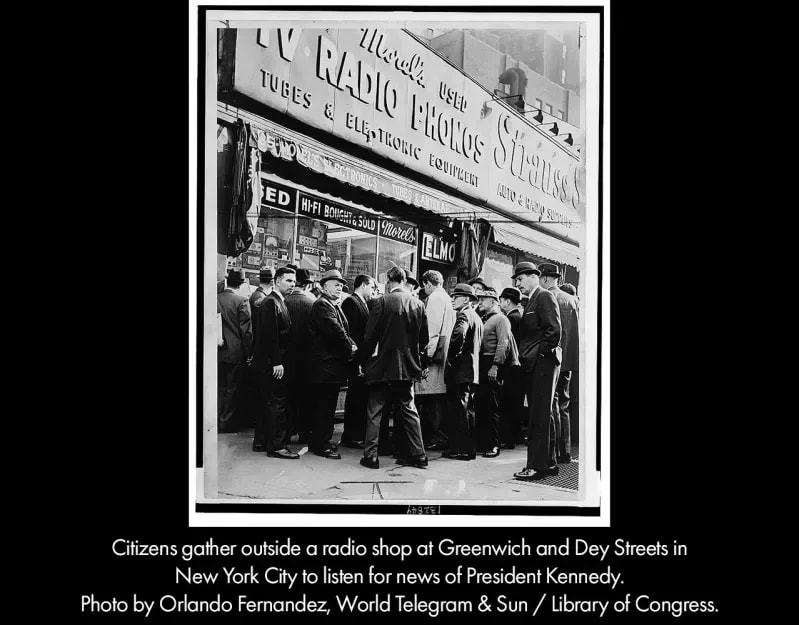
Many Americans who were alive in 1963 recall where they were when President Kennedy was assassinated in Dallas, Texas. Teachers cried in front of their students. Workers gathered around radios to follow the news. Catholics flocked to churches to mourn the first president who shared their faith. Beyond the shared shock, however, responses to Kennedy’s assassination differed based on cultural experience.
80% of American Jews had voted for Kennedy and many approved of his strong financial and military support for Israel. Northern synagogues like Congregation B’Nai Jeshurun on West 88th Street held packed memorial services where leaders eulogized the president’s commitment to peace, civil rights, and support of Israel.
Feelings in the Black community were less uniform. Prior to his presidency, there was little evidence of Kennedy’s commitment to civil rights. His support of an amendment to the Civil Rights Bill of 1957 favored by Southern legislators led to the executive secretary of the NAACP calling him a “compromiser with evil.” Kennedy also maintained friendly relationships with Southern segregationists in the run up to the 1960 election, causing Jackie Robinson to declare that he was not fit to be president. Still, Kennedy won the election by a narrow margin in key states, one of which was Illinois, where the support of Black voters was crucial. Once in office, Kennedy took modest steps toward civil rights, including creating the President’s Committee on Equal Opportunity, but did not pursue robust civil right legislation for fear it would derail his international agenda. The violent reaction to integration campaigns like the Freedom Rides pushed Kennedy to meaningful action. On June 11, 1963 he delivered a televised address to the nation on the issue, siding unequivocally with the civil rights movement and calling on all Americans to do the same. His administration then introduced comprehensive civil rights legislation, though the bill did not pass during Kennedy’s lifetime.
After his assassination, some Black Americans feared that Kennedy may have been killed by a racist who resented his support of civil rights, but there was also a feeling that his administration had not fulfilled its promises to Black voters. In a public statement after the assassination, the Rev. Dr. Martin Luther King Jr. summarized the tension saying, “I think President Kennedy made a most significant contribution to civil rights, and while he may not have done all that some feel he should have done, I will be the first to say that President Kennedy came forth with the most comprehensive civil rights bill that we have ever had from any president, and he had a great understanding of the depths and the dimensions of the problem…and he created a climate of civil rights concern in Washington and in the nation.”
Northern Jews and Southern Jews in the Civil Rights
Movement.
Many Northern Jews held strong progressive views as a result of the influence of Reform Judaism and its emphasis on social justice, as well as their historical experience as a persecuted group. They participated passionately in the civil rights movement, including helping found the NAACP. Jewish organizations submitted legal briefs supporting school integration in the Brown v. Board of Education case as well as many others. At least 30% of the white Freedom Riders were Jewish while 50% of the Mississippi Freedom Summer volunteers were Jewish Americans. Many Northern Jews also picketed segregated establishments, marched in demonstrations and protests, faced arrest and jail time, and as racist opposition escalated, risked violence and death in the fight for equality.
The experience of Southern Jews was very different. Unlike in Northern cities with significant Jewish populations, Jews never made up more than 1% of the population of the South. As a religious minority group with a history of persecution, Southern Jews knew that “their acceptance as whites was entirely conditional on their continued compliance with the prevailing social order,” as historian Clive Webb states in Fight Against Fear: Southern Jews and Black Civil Rights. In the deep South, Jews were pressured to join White Citizens Councils or else lose customers, bank loans, and police protection. In 1957-’58, the KKK used the growing integration crisis to launch anti-Semitic violence on Jewish temples. As civil rights activities increased, only a small number of Southern rabbis spoke out in support; most Jews took a more conservative stance, and outside of the major cities like Atlanta and New Orleans, few Southern Jews participated in civil rights activities.
Despite clear demographic differences in responses to the assassination of President Kennedy and the civil rights movement, each American alive in the 1960s made their decisions about whether to engage with the movement based on personal factors as well as their cultural experience. Were they full-time caregivers for dependent relatives? Could they afford to lose a job? Did they have close relationships with people from different backgrounds? Did they feel safe to take a stand? Americans today consider these same factors as they engage in protest against the inequalities and moral outrages of our own time.
References:
Allen, Candace. “How John F Kennedy’s Assassination Spurred the Drive for Racial Equality.” The Guardian, Guardian News and Media, 19 Nov. 2013.
Bigart, Homer. “Shift to Kennedy by Jews Is Noted.” The New York Times, 3 Nov. 1960.
Glass, Andrew. “Kennedy Narrowly Defeats Nixon, Nov. 8, 1960.” POLITICO, 8 Nov. 2018.
HelmerReenberg. November 23, 1963 – Martin Luther King Jr. Following the Assassination of President John F. Kennedy. YouTube, 23 Nov. 2019.
Joseph, Peniel E. “JFK’s 1963 Race Speech Made Him an African-American Icon.” The Root, The Root, 12 Jan. 2017.
Phillips, McCandlish. “Jews Here Recite Mourning Prayer.” The New York Times, 24 Nov. 1963.
Rowan, Carl T. “How Kennedy’s Concern for Negroes Led to His Death.”Ebony, Apr. 1967, pp. 27–34.
Vorspan, A., and D. Saperstein. “The RAC and the Civil Rights Movement.” Religious Action Center of Reform Judaism, Religious Action Center of Reform Judaism, 2021.
Webb, Clive. Fight Against Fear: Southern Jews and Black Civil Rights. University of Georgia Press, 2003.