Corporate workplace culture is an extension of the culture of the country. What has come from that is a capitalist system that privileges the structure of a corporate workplace crafted on exclusion, hierarchy, competition, and isolation. Like most things in America, it was a place and structure built specifically with white cis men in mind. To combat the inherent biases of this structure, Title VII of the Civil Rights Act of 1964 prohibits discrimination against an employee based on their race, color, religion, sex, or national origin. The enactment of a law that prohibits discrimination, however, does not mean that discrimination in practice has been eradicated. Alex Lin’s Chinese Republicans dramatizes the harsh realities that face those of marginalized identities in a workplace, specifically in the world of corporate finance. The U.S. Bureau of Labor Statistics reported in 2024 that 79% of workers in securities, commodities, funds, trusts, and other financial investments were white. Within that same subset, 38% were women and 12% were Asian. The women in Chinese Republicans are ostensibly successful and wealthy but not without struggles and challenges that come with being seen as “other.” They convene for monthly affinity group meetings, but connection to their cultural identities beyond that is suppressed in the name of survival and success. Alex Lin’s play is an invitation for us to consider how identity is connected to power and what people are expected to sacrifice as they chase the American Dream.
One way to understand the relationship between identity and power is through Sylvia Duckworth’s Wheel of Power/Privilege, adapted from Canadian Council for Refugees. The wheel is a useful visual aid for how different facets of identity can place one closer or further from power/privilege.
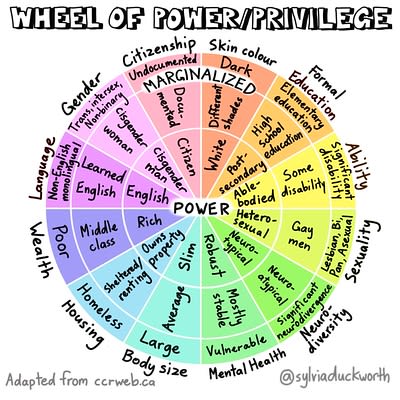
The wheel is limited when it comes to exploring these ideas through a lens of intersectionality. Kimberle Crenshaw, the legal scholar who coined the term, has said:
Intersectionality is a lens through which you can see where power comes and collides, where it interlocks and intersects. It’s not simply that there’s a race problem here, a gender problem here, and a class or LBGTQ problem there. Many times that framework erases what happens to people who are subject to all of these things.
So, referring back to the wheel, someone who holds multiple identities that lie towards the outside of the wheel experiences not only the marginalization of each of those identities, but also the marginalization of them combined. Those disadvantaged by their distance from power have been trying to both understand and solve the exclusion they continue to face. This can look like naming an issue as the first step in solving it as with the glass and bamboo ceilings. It also can take the shape of social movements like Lean In or the girlboss.
In a 1978 panel on women’s workplace advancement, then human resources professional Marilyn Loden coined the term “glass ceiling.” It’s evocative of limitations that are unseen or ignored. Loden wanted to encompass all the cultural barriers to success faced by women – biased attitudes of male managers, unequal pay, and a lack of role models and emotional support. Loden created this term in response to people who attributed women’s lack of advancement to their own faults, instead of hindrances placed upon them. She was identifying a lack of systems and structures that would provide women the same advantages of their male counterparts. Almost 30 years later, Jane Hyun drew inspiration from Loden’s term to address systemic issues facing Asian Americans. In 2005, Hyun published Breaking the Bamboo Ceiling: Career Strategies for Asians in which she defines the bamboo ceiling as “a combination of cultural, organizational, and individual factors that impede the career progress of Asian-American talent.” The book’s description assures Asian American readers it will help them “see the cultural barriers they subconsciously place in their own career paths and how to overcome them.” In 2010, Meta COO Sheryl Sandberg gave a Ted Talk addressing why there are so few women in top leadership roles. Her viral presentation inspired the book Lean In: Women, Work and the Will to Lead which aimed to “change the conversation” from what women can’t do to what they can do in an effort to create a more equal world; it offered research and real-life examples relating to the “ambition gap”, mentorship, negotiation disparity, and other similar challenges. In 2014, the girlboss entered the conversation as it was popularized by Sophia Amoruso’s book #GIRLBOSS that chronicled her journey as an entrepreneur and CEO. By 2017, the term #GirlBoss had reached over 2.5million hashtag posts on Instagram. Both Sandberg and Amoruso leveraged their books into sprawling networks, Lean In Foundation and Girlboss Media respectively, offering networking opportunities and supporting initiatives like Equal Pay Day.
Much like how the Civil Rights Act of 1964 didn’t eradicate discrimination in the workplace, Loden, Hyun, Sandberg, Amoruso, and many others’ efforts to combat discrimination have not had huge success. In fact, the online meme “gaslight, gatekeep, girlboss” popularized in 2021 illustrates a strong backlash to these movements. It captures the dissatisfaction many women, especially those who hold multiple marginalized identities, felt with these movements because they implied everyone should be striving towards a norm set by those at the center of the power wheel. Not only that, but it was communicated that it was their responsibility to shift behavior (e.g. negotiate your salary but smile the whole time!) to adapt to a hostile environment. Individualized advice for coping with structural problems is not going to make the changes necessary for one’s identity to not be a liability.
As you experience Chinese Republicans, consider how each character reacts or adapts to the structure that prevent them from reaching the center of the power wheel. You may also find yourself considering your own relationship to power and your identity or how you’ve made sacrifices in the name of success. The question for all of us to consider is: Do any strategies to outsmart structural inequity truly work in a capitalist, hierarchy that prioritizes the accumulation of wealth and power?