I Would Like–If I May–To Take You on a Strange Journey.
Though given one of the most polite opening lines in musical theatre, The Rocky Horror Show’s Narrator still feels out of place. The Narrator is defined by a distance from the rest of the cast, existing in their own reality and isolated from the madness of the plot. Whether played as a stuffy academic, a noir detective, or some kind of cheeky tour guide, the Narrator projects an air of rigid authority. This character is the anchor in the storm – a figure of total composure who shatters the fourth wall with the confidence of a professor delivering an oh-so-serious lecture.
This classic setup is both a tribute to and a parody of the “expert witnesses” found in mid-century B-movies. In those old sci-fi and horror films, an authority figure often appears to translate the danger for the audience. By adopting this persona, the Narrator triggers an expectation of safety; we are conditioned to trust the voice of the establishment. The skillfulness of the writing, however, lies in how quickly the Narrator betrays that trust, proving that the “expert” is just as confused as the rest of us. The effect is immediate and unsettling. While Frank-N-Furter struts in corset and heels, the Narrator looks as if having wandered in from a courthouse. The exaggerated normalcy makes the character feel surreal, and the audience instinctively latches on as a point of reason in a storm of chaos.
The Narrator isn’t just here to provide background info, but serves as a “straight man” whose initial detachment makes the story’s excesses stand out. As several drama analysts note, the Narrator serves as a bridge between the audience and the action – a representative of conservative society tasked with making sense of a sexual revolution. However, the role goes deeper than mere storytelling. It represents a clinical gaze – the attempt by those in power to classify, diagnose, and contain behavior they deem “abnormal.” This narrator isn’t just telling a story but trying to solve a problem.
The Logic of the Absurd.
From the first speech, the Narrator asserts presence as the absolute authority in the room. Positioned as a gatekeeper, this is a forensic expert promising to explain the events of that late November evening.
However, the audience immediately recognizes the joke: here is a formal observer trying to apply logic to a riotous, sexually charged, sci-fi fever dream. Comedy thrives on contrast, and the Narrator provides it in spades. The Narrator doesn’t dance the Time Warp, but documents and instructs it. The Narrator’s stillness makes the energy around the castle feel even more frantic, while performed seriousness makes everything funnier. The Narrator treats the absurd as if it were rational, reading choreography instructions as if presenting evidence to a jury.
Furthermore, the Narrator usually stays in a solitary space, physically separated from the castle. This separation reinforces the idea that this character exists in our world – the world of gravity and structure and taxes – rather than Frank’s world of lust and outer space and laboratory accidents. It creates a visual barrier that makes it even more shocking when the story eventually bleeds into the Narrator’s “safe” space.
By presenting the story in such an intellectual way, this narrator offers a “safe” lens into a world that is anything but. The character functions as a modern version of the Greek chorus, but with a twist: this is a chorus of one, an outsider who seems to know everything but has no power to change anything.
The Erosion of Authority.
Watching the Narrator’s composure crumble is one of the show’s quieter pleasures. Traditionally, this is the character who breaks the fourth wall most often, responding directly to audience callouts and asserting control by framing the chaos for us. But those interruptions, often expected and invited, are also the first fractures in authority. As the castle’s events escalate, the cracks deepen. The Narrator’s reactions to the show’s sexual freedom begin to register not as impartial observations, but as moments of recognition, curiosity, and even temptation. By the end, any intellectual distance has fully collapsed, and the commentary moves beyond the castle walls. What began as a case study becomes a comment on humanity itself, as the Narrator connects the madness before us to the shared condition of a species “lost in time, and lost in space, and meaning.” This narrator is a perfect example of Bertolt Brecht’s “Alienation Effect.”
Brecht believed that theatre shouldn’t just let the audience get lost in their emotions. Instead, the illusion should be broken repeatedly so the audience can think critically about what they are seeing. The Rocky Horror Narrator constantly interrupts the flow, reminding us that we are watching a performance and, in fact, becoming more and more engrossed in the frivolity. As scholar Sarah Taylor Ellis observes, this isn’t just a loss of control, but a revelation; the Narrator’s participation “complicates his distanced authority and discloses his pleasure in the fantastical, winding story,” proving that even the most rigid observer can’t resist the fun.
The Rocky Horror Show emerged during the 1970s, a time when rebellion was challenging every social norm. The Narrator’s inability – or unwillingness – to maintain order reflects society’s difficult struggle between traditional morality and new desires.
Experts on the Carnivalesque – a style of storytelling where social hierarchies are flipped – might argue that the Narrator isn’t really a true authority at all. In a carnival, kings are mocked and fools are crowned. The show becomes the ultimate carnival, and the Narrator is the symbol of the old order being stripped of its power. The more our narrator character tries to apply logic to an extreme sci-fi, pan-sexual story, the more foolish the character appears. This failure may, in fact, be the whole point of the character: old-school rationality has no power in the face of absolute pleasure.
A Field Guide to Musical Narrators.
The Rocky Horror Narrator is unique, but not quite alone. Let’s have a look at the lineage of musical theatre storytellers who guide, provoke, and sometimes upend the shows they inhabit.
The Manipulators
Some narrators are puppet-masters who drive the plot. In Pippin, the Leading Player is sly and masterful. Unlike the Rocky Horror Narrator, who is overwhelmed by chaos, the Leading Player orchestrates it. Similarly, the Chairman in The Mystery of Edwin Drood acts as an emcee for the evening; his procedural dominance allows him to impact the telling of the story and, in fact, its very resolution. While the Rocky Horror Narrator is a passive observer, these figures demand that the characters dance to their tune.
The Detached Observers
Detached observers are common in the first half of musicals, but most are eventually denied the safety of neutrality by the show’s conclusion. In the original Assassins, the Balladeer first appears as a folk storyteller, recounting history from a comfortable distance. Yet as the musical unfolds, he begins to comment, argue, and push back, attempting to influence the narrative itself. He starts as a detached observer, until the story demands his investment.
Into the Woods takes this to a violent extreme. The Narrator stands outside the frame, shaping events with a wink. However, the characters eventually realize that the Narrator is the source of their misery. In a moment of “failed narration” similar to Rocky Horror, the characters drag him into the action and sacrifice him. It proves that even the storyteller isn’t safe from the story.
The Shepherds of Memory
This is where the Rocky Horror Narrator lives: deadpan and professorial. The character shares this space with the “Man in Chair” from The Drowsy Chaperone, who invites us into his living room to listen to his favorite record as a way to hide from the real world.
We see a more dramatic version in Fun Home. Adult Alison hovers over the story, observing her own childhood memories. Like the Narrator in Rocky Horror, she is trying to solve a mystery: the mystery of her father’s life. Both characters use distance to protect themselves (at first), by treating the story like an artifact to be studied rather than a life to be lived.
The Moral Compasses
Sometimes, the narrator is a warning. The Emcee in Cabaret is the best example. Is he a guide or a demon? While the Rocky Horror Narrator might try to tame the chaos, the Emcee welcomes it, dancing the audience toward a horror that only he can see coming.
A similar figure appears in Blood Brothers. The Narrator in this show is a spectral, Brechtian figure who lurks in the background, constantly reminding the audience (and the characters) of the tragic debt that must be paid. Like the Emcee, he is the narrator who knows the ship is sinking – but keeps the band playing to ensure the lesson is learned.
The Time Travelers
Finally, there are those who bridge the gap between eras. The Narrator in Joseph and the Amazing Technicolor Dreamcoat is joyful and all-knowing, using a pop-concert vibe to make ancient history feel modern.
Meanwhile, the Arbiter in Chess (in the 2025 revision) serves as a referee and narrator, framing the Cold War stakes for the audience. Unlike our Rocky Horror friend, the Arbiter can actually enforce boundaries and clarify the chaos. Critics have described this new version of the character as a “genial” narrator who delivers a “wink-wink” commentary on the absurdities of the era.
The Mythic Guides
In recent years, a “bluesman observer” with a lot of soul has emerged, typified by Hermes in Hadestown. Like the Rocky Horror Narrator, Hermes is responsible for overseeing a tragedy he knows will happen. But instead of cold facts, Hermes narrates with empathy and heart.
A similar dynamic is found in Passing Strange, where the autobiographical Narrator guides the audience through the story of his younger self. He acknowledges the circular nature of the journey but chooses to sing it anyway, offering a spiritual resilience that a detached narrator lacks.
-

From left: Patricia Hodge as Catherine, Paul Jones as Pippin, Nicky Cheeseman as Theo, and Northern J. Calloway as Leading Player in Pippin at Her Majesty’s Theatre, Haymarket, London, October 1973. Photo by Donald Cooper / Alamy Stock Photo. -
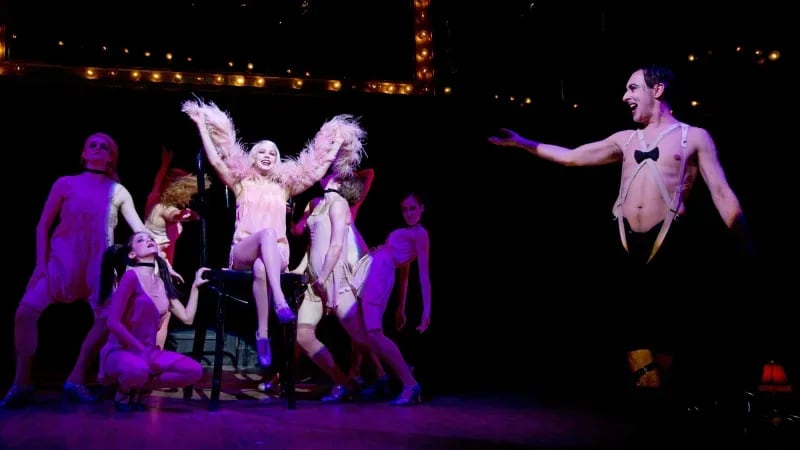
Alan Cumming, far right, as the Emcee in Roundabout’s 2014 production of Cabaret. Photo by Joan Marcus. -
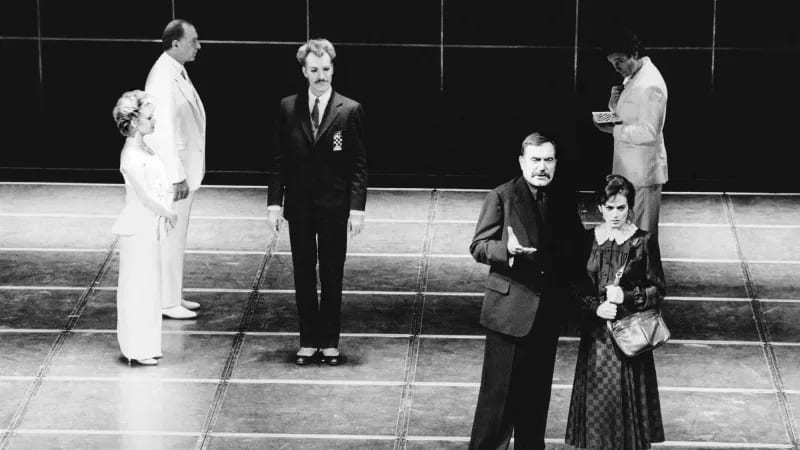
Tom Jobe (third from left) as The Arbiter in Chess at the Prince Edward Theatre, London, May 1986. Photo by Donald Cooper / Alamy Stock Photo.
Narrators carry a lot of weight. They anchor sprawling stories, provide clarity, and sometimes purposefully mess with the audience to make them think.
The Rocky Horror Narrator stands apart because the stiff, formal style actually makes the chaos feel more intense. This is a study in failure – the failure of logic to explain love, and the failure of authority to contain desire. Inherent composure highlights the absurdity of Frank-N-Furter’s world, and an eventual collapse shows how futile it is to try and put the human experience into a neat little box. Our Narrator blurs the line between analyzing the world and actually being swept up in it.
In the final lines, the Narrator proclaims that there is no meaning for humans on this planet, speaking not with authority but with total acceptance. The Narrator has lost control, yet keeps speaking until the end. And that is the narrator’s burden: to observe, explain, and endure a world that refuses to make sense.